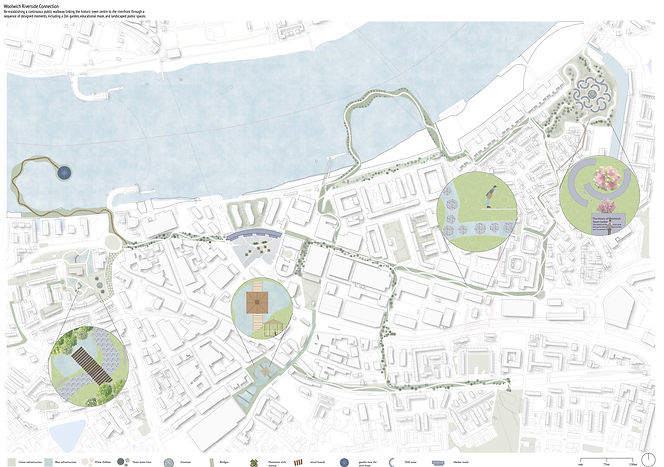
Initial Masterplan
The initial master plan explored multiple potential pathways for development, mapping out different directions the project could take. After completing this master plan, I identified and outlined the key issues and various aspects that needed further consideration, which helped guide the next stages of the project.

Initial Design codes
My earlier design codes were largely inspired by my protagonist, serving as a foundation for exploring form, structure, and spatial relationships. Some of the pathways and spatial arrangements drew inspiration from the Feng River Wetland Park in Shaanxi, China, which helped me think about flow, movement, and how users experience a space. These codes reflected the character’s personality and journey, providing a framework that guided my initial experiments and informed the development of later projects.
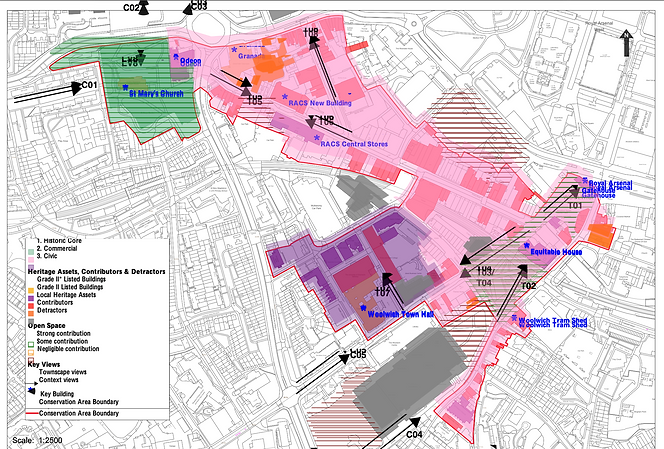
Heritage assets at Woolwich
The map highlights areas that are locally significant to the site, including heritage sites and open spaces. I later used this information in my site analysis to understand the context, identify key opportunities and constraints, and inform the design decisions for my projects. This step helped ensure that my work responded thoughtfully to the surrounding environment and its cultural and ecological features.

inspiration
My earlier design ideas were largely inspired by my protagonist, serving as a foundation for exploring form, structure, and spatial relationships. Some of the pathways and spatial arrangements drew inspiration from the Feng River Wetland Park in Shaanxi, China, which helped me think about flow, movement, and how users experience a space. These codes reflected the character’s personality and journey, providing a framework that guided my initial experiments and informed the development of later projects.

Plan of the Feng river
I appreciate how the plan organises pathways, water features, and open spaces in a way that balances ecology, recreation, and cultural significance. The structure and flow of the park inspired me to think about how movement, experience, and storytelling can be embedded into a site, and I used these insights to inform some of the pathways and spatial arrangements in my own work.
Sketches of ideas


Pathway Concept:
The first sketch explores the pathway concept, inspired by the flow of spaces I observed in the Feng River Wetland Park. Here, the walk runs along a planted area, with vegetation draping over the wall in a way that recalls the lavender-like terraces in Feng River. The design emphasizes movement and experience, guiding visitors through the site while creating moments of discovery and immersion within the landscape.
Maze Concept:
The second sketch introduces a maze-like concept, also drawing inspiration from the Feng River Park. In this version, pathways are framed by dense vegetation and bushes, creating an intricate network of spaces that encourages exploration. The interplay of open paths and enclosed greenery adds a sense of mystery and engagement, allowing users to interact with the landscape in a more intimate and playful way.
Hut Concept:
The third sketch focuses on a hut located in the corner of a lake, designed as a small retreat within the site. Wooden steps lead visitors across the water, creating a gentle transition from the main paths to the hut. This element not only provides a functional space but also enhances the connec